


There are a few dishes whose names have travelled around the world faster than the recipes themselves – goulash is exactly one of them.
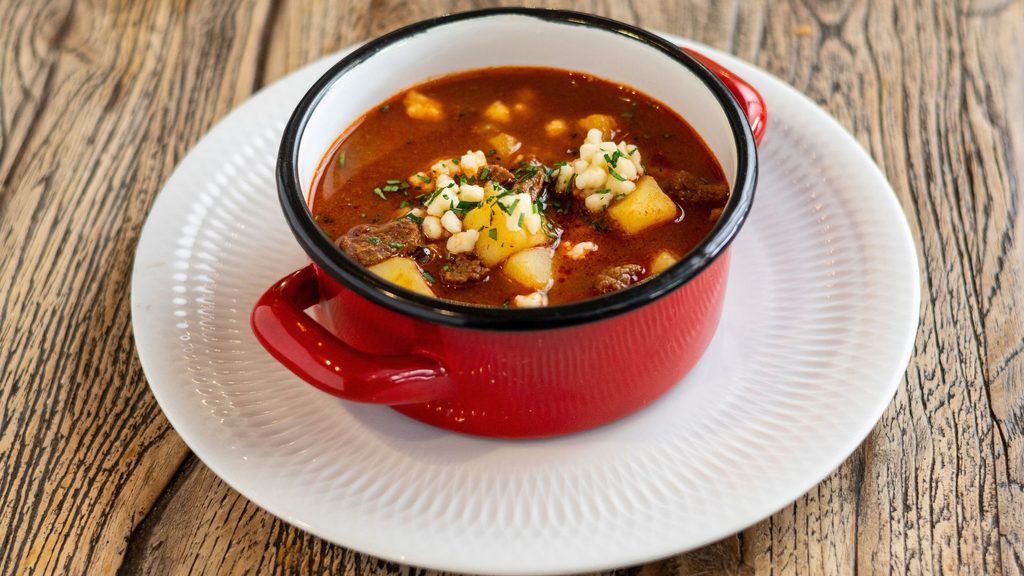
In Berlin, it may be a thick ragout, in London a paprika stew, while in America almost any beef one-pot dish can sometimes be given the name “goulash”. In Hungary, however, we have a very different idea of it. Brothy, rich with paprika, hearty and meaty, but not thick like a sauce. It contains onions, potatoes, often csipetke, and enough broth that no one could mistake it for a pörkölt.
What makes a goulash truly Hungarian? And can the same dish be equally authentic in an old-fashioned neighbourhood restaurant, a contemporary bistro and an elegant restaurant? And where can you find the best goulash, the kind that is definitely worth stopping in for?
Where should you eat goulash in Budapest?
Across Zsidai restaurants, you can currently encounter goulash approached in several different ways, and this is precisely what shows just how many faces the same dish can have.
Pest-Buda: the grandmother-style version
If we start from the classic, homestyle side, Pest-Buda, located on Fortuna Street in Buda Castle, is an almost obvious choice. By its own definition, the restaurant carries on the world of traditional Hungarian eateries and grandmother’s cooking. The current menu features traditional goulash soup with csipetke. Here, the story is not about reinterpretation, but familiarity.
It is exactly the kind of soup that instinctively makes you reach for a piece of bread. If someone would like to discover the dish for the first time in the atmosphere of a classic Buda Castle restaurant, this is one of the most natural places to start.
21 Hungarian Kitchen: when tradition does not stand still in time
A few buildings away, we find a completely different approach. According to the philosophy of 21, the traditions of Hungarian cuisine should be respected, but they do not need to be preserved unchanged.
This is a good example for anyone who, behind the idea of a Hungarian restaurant in Budapest, is looking not for folk-inspired décor, but for contemporary Hungarian gastronomy. The recipe remains recognisable, while the setting and culinary approach are more contemporary.
Pierrot: the elegant side of goulash
Goulash does not have to arrive on a chequered tablecloth. Pierrot is an elegant Hungarian family restaurant housed in a 13th-century building, where classic Hungarian dishes are reinterpreted in a more refined form. Its menu features goulash made with beef cheek, potatoes, vegetables and csipetke. This version clearly demonstrates that the identity of a traditional dish is not necessarily lost simply because it is served in a more elegant setting.
It suits a different occasion than an everyday lunch at a neighbourhood restaurant, but it draws on the same gastronomic memory.
Fekete Holló: a neighbourhood restaurant in the rhythm of the locals
The concept of Fekete Holló deliberately evokes the world of old Budapest neighbourhood restaurants. The owner also highlights goulash, pörkölt, mákos guba and pancakes among the dishes that represent this homestyle world.
Interestingly, the restaurant also specifically reaches out to the Budapest community: it operates a local discount programme for people who live and work in Budapest.
So, if someone is looking for the experience of a Buda restaurant that is less formal and feels more like a regular local haunt, Fekete Holló brings a different character to Hungarian classics.
Spíler Original: goulash in the middle of the downtown buzz
The current menu at Spíler Original in Gozsdu Courtyard also features goulash soup with homemade sourdough bread, but here it is bean goulash that you can try.
The setting is completely different: amid the evening buzz, a gastropub atmosphere, burgers and international comfort food, a Hungarian classic makes an appearance.
The history of goulash: if you want to do more than just taste it
The history of goulash began long before English translations appeared alongside it on Budapest menus.
Hungarian ethnographic literature links the origins of the dish to the pastoral culture of the Great Hungarian Plain. It was a simple meat dish prepared in a cauldron by cattle herders, based on meat, onions and, later, paprika. According to research, goulash/pörkölt-type dishes may have been present in the cooking of cattle herders on the plains for centuries, and Mátyás Bél had already described this cooking method around the 1730s.
Goulash soup itself is a later form. According to ethnographic sources, the version known as a soup began to appear regularly from the 1880s onwards, while the shepherds’ dish became a national symbol.
At the turn of the 18th and 19th centuries, the paprika-based meat dish increasingly emerged as a symbol of Hungarian cultural distinctiveness, and later became one of Hungary’s best-known dishes in hospitality and, subsequently, tourism. In other words, when a visitor orders goulash in Budapest today, they are essentially sitting down to the latest chapter of the same story.
What makes a goulash soup truly ours?
The Collection of Hungarikums quotes Károly Gundel’s definition: goulash is a soup prepared with plenty of broth, onions and paprika, with diced potatoes and csipetke. The source specifically highlights that a good goulash soup is not thickened and that high-quality paprika is a defining element.
This is important because abroad, the word goulash often refers to a thick beef ragout. In Hungary, beef goulash soup is a hearty soup that can easily be eaten with a spoon. The meat should be tender but not falling apart; paprika should give it its character, rather than a heavy flour-based thickening.
How to recognise a good goulash
- It is brothy, not a thick, pörkölt-like ragout.
- The paprika has character but does not overpower every other flavour.
- The meat is tender, yet still holds its shape.
- The potatoes and vegetables are not cooked to mush.
- Ideally, the csipetke really is csipetke, not simply another soup pasta.
- It does not need elaborate “Hungarian-style” decoration to be authentic.
- With fresh bread, it can stand on its own as a complete lunch.
What else should you try after goulash?
If someone is discovering Hungarian cuisine for the first time, it would be a shame to stop at just one soup.
Chicken paprikash with galuska, Hortobágyi meat-filled pancakes, beef pörkölt, stuffed cabbage or crispy duck leg each reveal a different side of the same culinary way of thinking.
For dessert, there is Gundel pancake, aranygaluska, mákos guba or túrógombóc.
There is no need to squeeze them all into one dinner. Hungarian cuisine is probably best understood when given more than one occasion.
Is goulash for tourists? Of course. And it is just as much for us, too
Perhaps this is the dish’s most interesting characteristic. It is simultaneously one of Hungary’s best-known tourist symbols and a completely everyday dish.
It can be found in elegant restaurants, at family lunches, at festivals, cooked in a cauldron and served in neighbourhood restaurants. The world recognises its name, while we continue to think of it simply as soup.
For a foreign visitor, it is therefore a good introduction to Hungarian gastronomy. For someone from Budapest, it is not necessarily a culinary discovery, but rather something familiar that is good to return to from time to time.