


There is a scent every Hungarian recognises. Hot oil, freshly fried dough, somewhere along a busy market lane or on the edge of a summer festival. It needs no introduction: it catches your attention instantly and takes you straight back to childhood. Lángos is more than just food. It is a feeling, a memory, a piece of our shared Hungarian heritage that you can hold in your hands—and one that almost always leaves your fingers just a little bit greasy..
The Dough That Stood the Test of Time
The history of lángos goes back much further than most people realise. Its name comes from the Hungarian word láng (“flame”), as it was originally baked beside the flames of a wood-fired oven as a by-product of bread baking. Once the oven had been heated, a small piece of the leftover dough was quickly flattened and baked so that nothing went to waste. It was the homemaker’s little reward after hours of kneading: warm, crispy, and ready to enjoy immediately. From these humble beginnings, lángos went on to become one of Hungary’s most beloved street foods.
It is fascinating to think about how many different eras lángos has lived through. At times it was food for the poor; at others, it was a festive treat. It evolved from a simple beach snack into a Sunday tradition. During the decades of socialism, it became an indispensable part of buffet counters across the country, brushed with garlic water and generously topped with sour cream and grated cheese. Generations grew up with the image of their grandmother handing over a steaming piece of fried dough wrapped in a kitchen towel.
Then came change. Over the past fifteen years, Budapest’s gastronomic scene has undergone a remarkable transformation. Fine dining restaurants appeared, artisan cafés flourished, and the city’s culinary landscape embraced the most exciting international influences. Many assumed that lángos would be left behind—too simple, too greasy, too old-fashioned. The exact opposite happened.
Tradition Became Fashionable Again
The renaissance of retro lángos in Budapest is no coincidence. As the city became faster-paced and increasingly international, people began craving something authentic. Something that was not a passing trend, but a true expression of their roots. Lángos offers exactly that: a connection to the past and a flavour that has no desire to be anything other than what it is.
Today, lángos is no longer a modest supporting act. It proudly takes its place on the stage of Hungarian gastronomy, and more and more restaurants prepare it with the care and respect it deserves. Because making truly good lángos is far from simple. The texture of the dough, the proofing time and the temperature of the oil all determine whether the result is light and crisp or heavy and greasy.
This is where mass production gives way to craftsmanship. It is also where a philosophy comes into play that does not lock classic recipes away in a museum, but keeps them alive.
A Classic Recipe Worth Preserving
If you’re looking for authentic lángos, it is worth asking what truly makes a recipe “classic.” It is not about elaborate toppings. Rather, it begins with the essentials: high-quality flour, patient proofing, and frying it fresh to order. Grandmothers never relied on secret ingredients—their secret was always time and care.
This is precisely the philosophy of Fekete Holló Kisvendéglő. This cosy Hungarian restaurant in the heart of Budapest represents a cuisine that does not simply dust off traditional Hungarian flavours, but takes them seriously. Here, old recipes are not nostalgic decorations—they are a living heritage. The atmosphere reflects the same approach: dark wood interiors, intimate spaces, and the feeling of stepping into another era, where food carries both substance and a story.
In surroundings like these, lángos is no longer just a quick bite. It becomes a gesture towards the past—a reminder of where we come from.
Modern Lángos: The Same, Yet Different
What is the difference between traditional and modern lángos? Less than you might think—and yet exactly enough to matter.
The traditional version offers the timeless trio: garlic, sour cream and cheese. Simple, perfect and unquestionable. Cheese lángos has been the safest choice for generations—the kind of comfort food that never disappoints.
The modern interpretation, however, is more adventurous. It may be topped with shredded duck confit, cottage cheese with dill, smoked fish, roasted onions, or even caviar. The goal is not to reinvent the dish, but to respect it. A good modern lángos never forgets its foundations—it simply builds upon them.
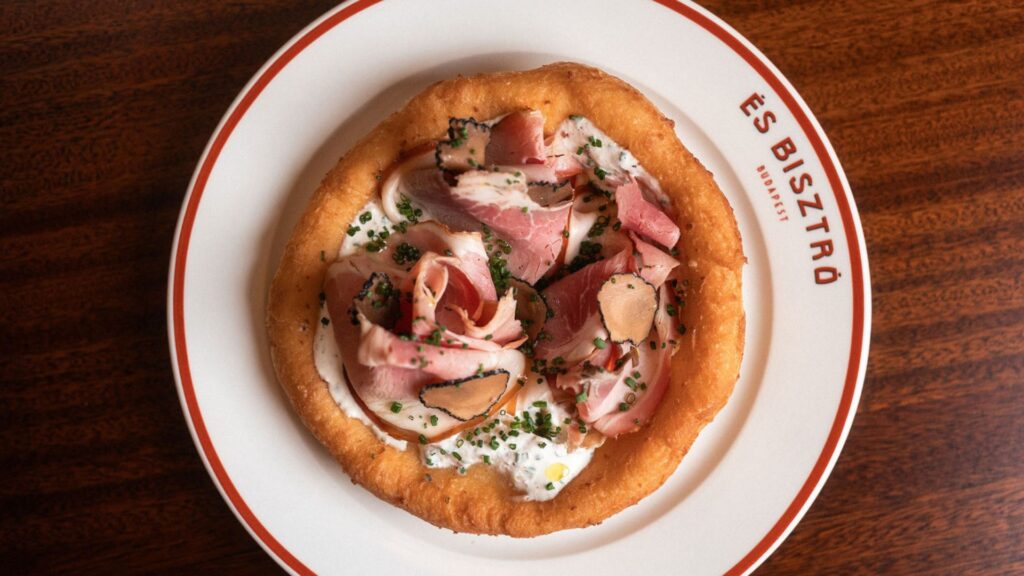
This balance is elegantly represented at ÉS Bisztró. Here, Hungarian gastronomy reveals its contemporary, urban character, where traditional flavours are presented in a modern way while preserving their soul. It is a place where even a classic bite is seen from a fresh perspective without losing what makes it unmistakably Hungarian. The Lángos Supreme, for example, is prepared with prosciutto arrosto, Gran Tartufo cheese and sour cream.
The Most Popular Lángos Toppings – and Why We Love Them
Walk through any part of the city where lángos is served, and certain toppings appear again and again. For good reason.
- Sour cream and cheese: the timeless classic, the benchmark against which all others are measured. Simple, creamy and crisp.
- Garlic: the finishing touch that many believe is essential. A single brushstroke that changes everything.
- Sausage and onion: the heartier, more substantial version that can easily replace an entire meal.
- Sweet versions: topped with jam, powdered sugar or sometimes Nutella—the flavours of childhood in a grown-up form.
Topping trends continue to evolve, but the principle remains the same: lángos is a blank canvas on which everyone can express their own taste. Perhaps that is why it has remained so relevant after all these decades.
How Much Does a Lángos Cost in Budapest Today?
It is only natural to wonder what lángos costs on the streets of Budapest today. The truth is that prices vary considerably. A simple market-style lángos with sour cream and cheese generally falls into the lower price range, while artisan versions made with premium ingredients or those served near major tourist attractions can command significantly higher prices.
But the price of lángos is about more than the dough itself. It reflects the quality of the ingredients, the surroundings, and the overall experience. A carefully prepared, freshly fried lángos served in a quality restaurant belongs to an entirely different category than one hastily made. As with everything else, making a thoughtful choice is worthwhile.
The Best Lángos in Budapest: What to Know Before You Order
Lángos is more than street food. Before you enjoy your next crispy bite, here is a quick checklist of what to look for—and where it is truly worth trying.
- Freshly fried is always best. The perfect lángos is crisp on the outside, light on the inside, and still steaming when it reaches your hands. If it is already lukewarm, you’ve missed the best part.
- Don’t skip the classic. Cheese lángos with garlic and sour cream is the benchmark against which everything else is measured. Simple, creamy and timeless. If it is your first time, start here.
- Give tradition the respect it deserves. At Fekete Holló in Buda Castle, retro lángos is not nostalgia—it is living heritage. A taste of Lake Balaton in the heart of Budapest.
- Experience its modern side as well. ÉS Bisztró offers a contemporary, urban interpretation, where lángos appears in a more elegant form while remaining true to its roots.
- Plan for the price. Quality is worth choosing consciously.
- Choose according to your mood. Looking for cosy historic surroundings filled with wood and character? Visit Fekete Holló Kisvendéglő. Prefer a modern, vibrant and contemporary atmosphere? Head to ÉS Bisztró. Both offer the same essentials: freshly fried dough, quality ingredients and an authentic experience.
One Bite of Lángos, One Bite of the City
Ultimately, lángos is about far more than flour and oil. It tells the story of a nation—of how we preserve tradition while continuing to move forward. That is precisely what makes Budapest’s food scene so fascinating: here, the past and the present do not compete with one another—they strengthen each other.
The next time you bite into a hot, crispy lángos, take a moment to think about everything contained in that single bite: generations of home kitchens, the bustle of local markets, summer afternoons, and a city that has never forgotten where it came from. Whether you seek this experience in the intimate dining rooms of Fekete Holló in Buda Castle or in the contemporary atmosphere of ÉS Bisztró, you will discover the same thing: a taste of Budapest itself.