


There is a version of Budapest that can be completed in 48 hours: Parliament, Chain Bridge, Fisherman’s Bastion, a thermal bath; a ruin bar; goulash. Perhaps a Danube cruise before catching the airport bus. And then there is the Budapest people actually live in.
It starts with the sound of a tram arriving before breakfast, a coffee that turns into a forty-minute conversation and the completely normal idea that soaking in thermal water can be part of an ordinary weekday. It means crossing the Danube because the weather is better on the other side, meeting friends on a terrace without deciding when the evening will end, and discovering that Sunday lunch is not something to rush.
If you really want to live like a local in Budapest, the secret is not finding places tourists have never heard of. In a city these popular, genuinely secret addresses rarely remain secret for long. The better trick is learning how Budapest uses Budapest.
Where should you stay for a more local Budapest experience?
The answer depends on which version of the city you would like to borrow for a few days.
If nightlife matters, District VII. —Erzsébetváros, better known to visitors as the Jewish Quarter— puts you within walking distance of courtyards, bars, galleries and the city’s famous ruin-bar culture. But there is a difference between staying close to the action and spending your entire trip on the busiest streets. Local nightlife increasingly spills beyond the most tourist-heavy section of Gozsdu towards places such as Madách tér, while the wider district still rewards aimless daytime wandering.
For something slower, look across the Danube. District XI., particularly around Bartók Béla út, has become one of Budapest’s most interesting cultural neighbourhoods, with galleries, terraces and a distinctly lived-in atmosphere. Margit-negyed, around Margit körút, offers another Buda alternative: connected to the centre but less shaped by sightseeing itineraries. Current local guides highlight both as areas where Budapesters increasingly spend their own leisure time.
And then there is the Buda Castle District. Yes, it contains some of Hungary’s most photographed attractions. But stay after the sightseeing groups leave and the mood changes. Early mornings and later evenings reveal quieter streets, neighbourhood regulars and a very different Castle from the one seen at midday.
That difference in timing is one of the first local habits worth borrowing.
7 ways to experience Budapest more like a local
- Ride the tram instead of treating every journey as a transfer. Routes along the Danube are part transport, part moving city panorama.
- Do one major attraction early, then stop planning every hour.
- Spend time on both sides of the river. Pest brings energy; Buda gives you space.
- Go to a thermal bath because you want to slow down, not simply because it appears on a must-see list.
- Eat lunch properly. Budapest works surprisingly well when the middle of the day is allowed to last.
- Choose neighbourhoods by mood rather than by their ranking on Instagram.
- Revisit somewhere after dark. The Castle District, the riverbank and downtown courtyards feel completely different once the daytime crowds disappear.
The thermal bath is not an attraction… it is a ritual
Few things reveal Budapest better than its relationship with thermal water. Visitors often experience the baths as monumental sightseeing destinations. Budapesters are more likely to think in practical terms: which bath is nearby, where can I swim, where can I spend a quiet morning, and where should we meet this weekend?
Széchenyi remains the grand icon, but Lukács Thermal Bath has long had a particularly local reputation, while Rudas combines centuries of bathing culture with spectacular views over the Danube. In warmer weather, Palatinus on Margaret Island shifts the experience outdoors. Budapest’s official spa network currently includes all of these facilities, reflecting how broad bathing culture is beyond a single postcard-famous location.
The most Budapest thing you can do is therefore not necessarily choosing the biggest bath. It is giving the bath enough time. Do not schedule a museum forty-five minutes later. Swim. Sit. Read. Talk. Do absolutely nothing for a while. That is the point.
Where do Budapesters eat when they want Budapest rather than a performance of Budapest?
Authenticity becomes complicated in cities visited by millions of people. An old building does not automatically make a restaurant authentic, just as a modern interior does not make it less local. The more useful question is whether a place still participates in the everyday life of its neighbourhood.
The Castle District offers a surprisingly good example.
Fekete Holló describes itself as an old-school Budapest tavern rather than a polished interpretation of one. Its roots reach back to the 1930s. Its local character is more than storytelling: Fekete Holló offers a dedicated discount card for Budapest residents and people working in the city, reinforcing its ambition to remain a genuine neighbourhood tavern rather than simply another Castle District stop for visitors.
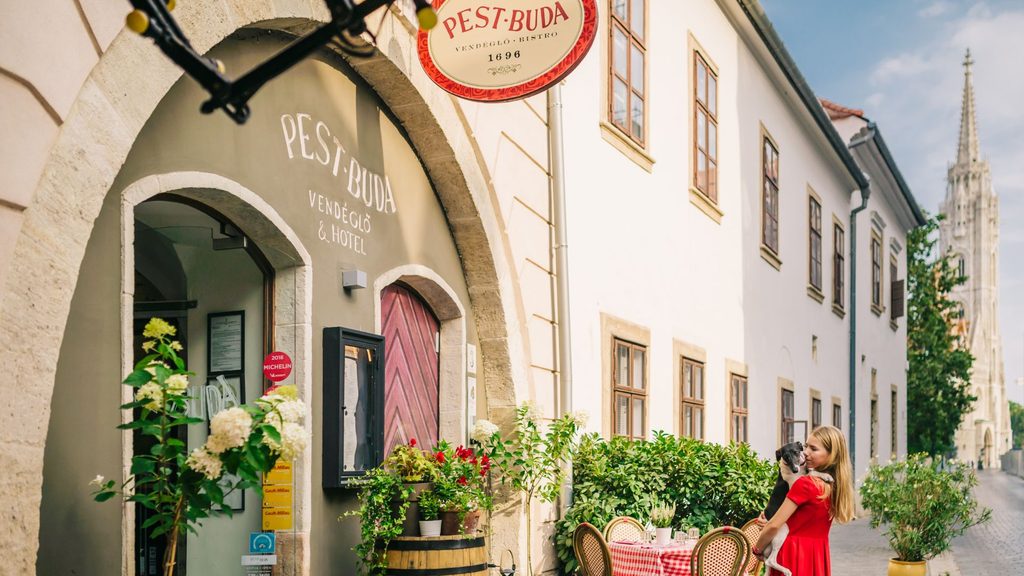
Nearby, Pest-Buda Bistro offers another kind of continuity. Its building has been associated with hospitality since 1696, while the current restaurant focuses on Hungarian comfort food and the sort of dishes associated with home cooking and long family lunches.
If your search for a Hungarian restaurant Budapest has produced too many places trying very hard to look traditionally Hungarian, 21 Hungarian Kitchen offers the opposite approach: Hungarian classics viewed through a contemporary lens rather than through folklore decoration. We describe the restaurant’s philosophy as respecting tradition while allowing Hungarian cuisine to evolve.
And when the evening calls for grilled food, wine and less ceremony, Baltazár deliberately positions itself as the Castle District’s shared living room—a neighbourhood place for dinner or simply a few glasses rather than a monument to fine dining.
That variety is closer to how residents actually use a city: not searching for the single “most authentic” restaurant, but choosing a place according to the evening.
Budapest nightlife: go where the night naturally takes you
Ruin bars are now inseparable from Budapest’s international image, yet they began as something very local: neglected courtyards in District VII. transformed with second-hand furniture, improvised decoration, music and very little concern for conventional hospitality design. Their success eventually made the neighbourhood itself one of Europe’s best-known nightlife destinations.
Trying to recreate the Budapest nightlife of twenty years ago is therefore missing the point. Cities change. What remains recognisably Budapest is the habit of moving through several kinds of space in one evening: drinks in a courtyard, somebody suggesting another place, music appearing somewhere unexpectedly, and dinner turning into late-night drinks without anyone formally deciding that this is what is happening.
In Gozsdu Udvar, Spíler Gozsdu has been part of that story since the Zsidai Group opened it there; the group describes the venue as one of the places that helped redefine the city’s nightlife. For travellers typing spíler gozsdu into their phones, this is the address they are looking for—but the more local approach is to put the phone away once you arrive and see where the evening goes.
What does a Budapest weekend actually feel like?
It rarely begins with eight scheduled attractions. A Saturday might start slowly, move towards a market or a walk beside the Danube, continue with an exhibition or a few hours in a bath, and eventually end around a table. On sunny days, Margaret Island fills with runners, cyclists, families and groups of friends. In Buda, neighbourhood terraces begin filling long before evening. In Pest, the streets around the Jewish Quarter and central squares become progressively louder as afternoon turns into night.
Sunday has a different rhythm. Long lunches make sense here. So do baths, parks and aimless walks. The Castle District works particularly well on a Sunday when there is no need to race from Matthias Church to Fisherman’s Bastion and immediately back down the hill. Wander instead. Take the smaller streets. Stop for coffee. Stay for lunch.
A city starts feeling local when you allow yourself to waste a little time in it.
How to avoid Budapest’s tourist traps without avoiding tourists
The usual advice is to leave the centre. That is too simple. Locals use central Budapest too.
The smarter strategy is to change your timing, expectations and pace. Visit famous viewpoints early or late. Do not choose a restaurant simply because someone is standing outside persuading you to enter. Be suspicious of any itinerary that requires you to cross the city four times before lunch. And remember that a place does not become inauthentic simply because visitors have discovered it.
Gozsdu can be crowded and still be worth experiencing. Fisherman’s Bastion can be famous and still feel magical at 8 a.m. The Castle can contain world-famous sights and still have neighbourhood restaurants where Budapesters return for lunch. There is no contradiction.
The real Budapest is somewhere between Buda and Pest
Perhaps the biggest mistake visitors make is trying too hard to discover the “real Budapest.” There is no single one.
Budapest is morning mist over the Danube and Saturday-night noise in District VII. It is a chessboard beside thermal water, a dog walker on a Buda street, a tram packed at rush hour and a table that nobody seems ready to leave.
The goal is not to become a local in three days. It is simply to stop behaving like every minute of the trip needs to prove that you have been somewhere.
Ride the tram one stop too far. Spend another half-hour in the bath. Cross the river without a major attraction waiting on the other side. Order another coffee. Let lunch become afternoon. Because Budapest becomes much more interesting once you stop trying to complete it.